An Introduction to a Sacred Celebration
The Feast of Corpus Christi, also known as the Solemnity of the Most Holy Body and Blood of Christ, is a significant event in the Roman Catholic liturgical calendar. This day is dedicated to celebrating and honouring the Eucharist—the Body and Blood of Jesus Christ, present in the consecrated host and wine. For those new to Catholicism, the Eucharist is central to Catholic faith, embodying the spiritual nourishment and presence of Christ among His followers.
Why Is It Important?
The Feast of Corpus Christi is a manifestation of the deep reverence Catholics have for the Eucharist. It serves as a solemn reminder of the Last Supper, where Jesus instituted the sacrament of Holy Communion, commanding His disciples to continue the practice in memory of Him. This day underscores the belief in the real presence of Jesus in the Eucharist, which is a cornerstone of Catholic faith, and celebrates the gift of Jesus’s sacrifice and enduring love for humanity.
Origins and Celebration
The feast was instituted in the 13th century, inspired by visions of Saint Juliana of Liège, a Belgian nun who sought to have a day specifically dedicated to the Eucharist. Pope Urban IV officially established the Feast of Corpus Christi in 1264, setting a precedent for a tradition that spans centuries.
Celebrated on the Thursday following Trinity Sunday – 60 days after Easter Sunday (or on the subsequent Sunday in this country) – the day is marked with Mass, Eucharistic adoration, and a procession that is both a public profession of faith and a display of reverence for the sacrament of the Eucharist.
The Corpus Christi Procession: A Public Act of Faith
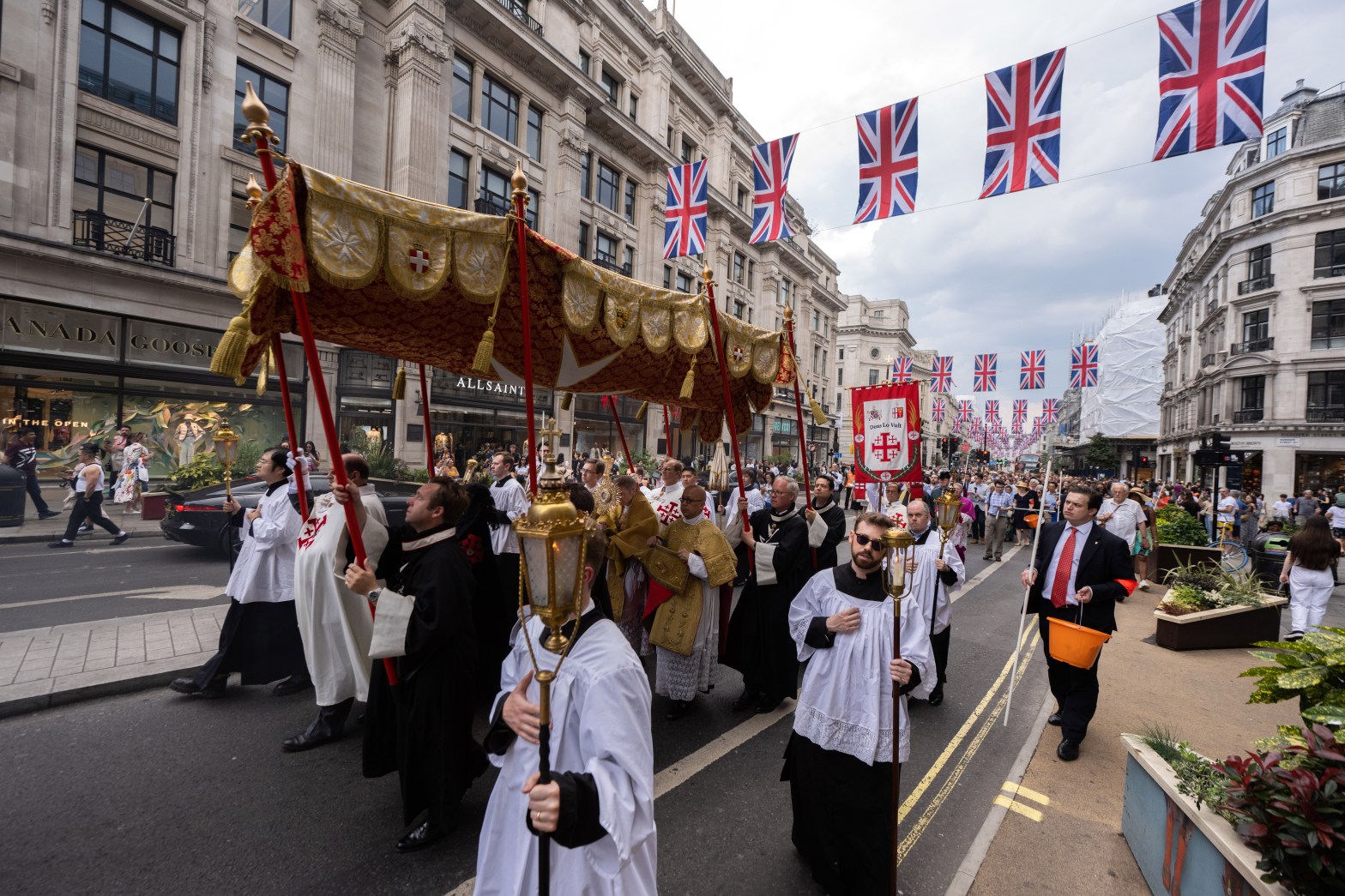
One of the most visually striking and publicly engaging aspects of the Feast of Corpus Christi is the procession. In this event, the consecrated Eucharist, placed within a monstrance (a special vessel designed to display the consecrated host), is carried through the streets by the clergy. The procession is accompanied by prayers, hymns, and often a significant number of the faithful, bearing witness to their faith and devotion in a communal act of worship and veneration.
Why Participate?
For Catholics, participation in the Feast of Corpus Christi and its procession is an act of deep personal faith and communal identity. It is an opportunity to publicly affirm belief in the real presence of Christ in the Eucharist and to celebrate the mystery of faith that unites believers in a global community.
Why Central London?
For British Catholics, participating in a Corpus Christi procession through Central London holds a distinct significance that transcends the spiritual into the realms of cultural identity and historical significance. The United Kingdom, with its complex religious history marked by periods of Reformation and conflict between Protestantism and Catholicism, has shaped a context where public expressions of Catholic faith carry profound meaning. Taking part in a Corpus Christi procession through the heart of the nation’s capital is not only an act of personal devotion but also a public declaration of the Catholic community’s enduring presence and vibrant faith in a historically Protestant country. This procession, weaving through the streets of London, serves as a moving testament to religious freedom, unity, and the resilience of Catholic tradition in Britain. For British Catholics, it is an opportunity to connect with their faith’s rich heritage, to stand in solidarity with fellow believers, and to bring the sacred mysteries of their religion into the public eye, fostering understanding and respect among the diverse tapestry of beliefs that characterise modern Britain.
Learn More and Join Us
Whether you’re new to the concepts of Catholicism or simply curious about the traditions and beliefs that shape this global faith, the Feast of Corpus Christi offers a window into the spiritual heart of Catholic worship and community. We invite you to learn more, ask questions, and even participate in the celebrations to experience first-hand the beauty and depth of Catholic faith.
 The London Eucharistic Octave 2026